

During the Ocean Science Meeting 2026, there was project members from OCEAN ICE who presented their current work and research.
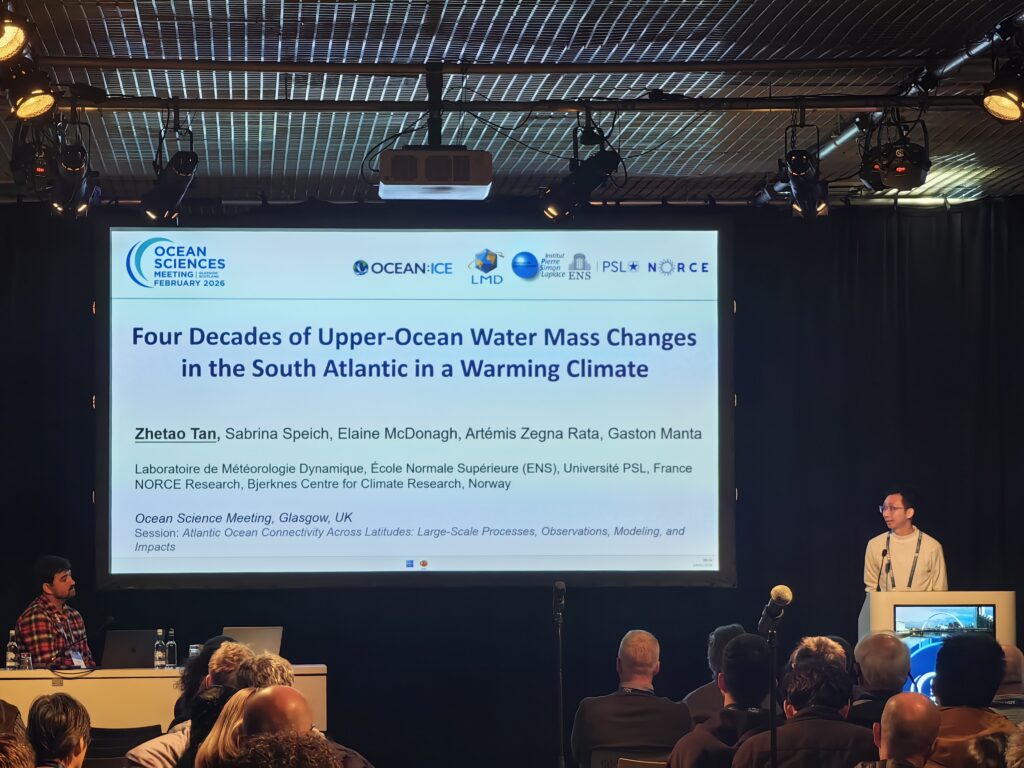
In OSM26, Zhetao Tan (post-doc in WP5) showed the latest progress on the South Atlantic long-term changes in different water masses. Based on the direct observations, we elucidated the phsyical process driving the compound change (temperature coupling with salinity) in response to global warming from the water mass perspective. We also took this opportunity to call attention to the ongoing climate transformations in the Global South, which should be placed in an equal role with the Global North in the ocean science community.
David Chandler: HE43A-09: Global impacts of Greenland and Antarctic ice sheet freshwater fluxes in the Norwegian Earth System Model (NorESM)
Here we presented results mainly focused on the climatic impacts of freshwater fluxes from Antarctica into the Southern Ocean. Our main finding was that the impacts of increasing ice melt in Antarctica on global climate are quite weak, especially if the main increase in freshwater fluxes comes next century. However, even if we find little global response, we still find that increasing freshwater fluxes from Antarctica cause subsurface warming in the Southern Ocean around Antarctica, with potential for positive feedback between warming and increasing melt.
HE44D-1022: Committed Southern Ocean warming and implications for the Antarctic Ice Sheet following emission cessation.
This study quantified how much long-term (centennial-scale) Southern Ocean warming we expect after a zero carbon transition. In this case we found that circumpolar deep water around Antarctica continues to warm after carbon emissions cease. Fortunately that warming doesn't reach Antarctica itself - around the coast we instead find cooling of CDW and shelf bottom water, which potentially helps to reduce ocean-driven ice melting of Antarctic ice shelves.
Article written by Zhetao Tan (Laboratoire de Météorologie Dynamique – IPSL) and David Chandler (NORCE)