

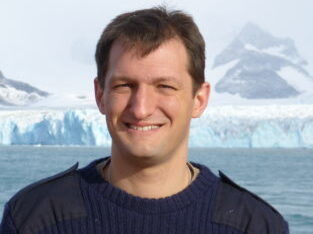
Andrew, please introduce yourself.
I'm Andrew Meijers, and I'm a science leader and physical oceanographer at the British Antarctic Survey, heading up the Polar Oceans team. I'm also one of the science coordinators for OCEAN ICE; I help run the project and represent the UKRI funded side of things.
Tell us about your professional and academic career before becoming part of the OCEAN ICE community.
I obtained my PhD in 2009 as part of the Quantitative Marine Science programme jointly run by the University of Tasmania and the Australian CSIRO. Following two short postdoctoral positions at the CSIRO in Hobart, I moved to Cambridge and the British Antarctic Survey in 2012. I have remained there ever since and eventually moved up to take over the Polar Oceans team in 2024. My research generally focuses on understanding the larger scale Southern Ocean circulation and its wider impacts. I'm an observationalist by training and have spent a lot of time at sea around Antarctica, but I find my most satisfying science comes from combining many (many!) observations into large datasets and combining and comparing these with models.
In my time I have looked at sub polar circulation, Antarctic Bottom Water export, SubAntarctic Mode Water formation and global ocean heat uptake. In recent years in particular I have focused on the representation (and associated problems) of the Southern Ocean in climate models. Interpreting these models and understanding their strengths and weaknesses has also allowed me to work with a variety of other teams, notably ecologists interested in understanding the implications of Southern Ocean climate change on their critters of choice!
What do you do within OCEAN ICE?
I co-lead OCEAN ICE with Ruth Mottram at DMI, and head up WP8: Science Coordination. As well as the coordination aspects, I'm developing a synthesis study combining the OCEAN ICE ocean models with CMIP and SOFIA datasets to examine the impact that Antarctic melt and freshwater fluxes have on the ocean circulation - particularly bottom water export and the climatic consequences of this. I'm also involve in the work of Shenjie Zhou and Rachael Sanders here at BAS looking at producing a new hydrographic climatology for the Southern Ocean and at Weddell Sea bottom water export respectively.
What have you enjoyed about OCEAN ICE so far?
My role means I get to see pretty much all the elements; fieldwork, modelling, outreach, and people in OCEAN ICE. I have to say that I have really enjoyed how the project has drawn me into the European research community and the opportunities it has presented to really engage with the excellent scientists working right across the continent. It has opened up a great deal of collaboration opportunities and impressed me with how collegiate and collaborative the community is!
Tell us about a skill or trait unique to you that you would like to share?
I took up watercolour painting partly due to the amount of travel OCEAN ICE made me undertake. I'd often find myself in a new city with a few hours to kill, and now rather than wandering aimlessly, I now wander aimlessly with a sketchbook and paint. It's something I've really taken to and will carry on long after the project!
Stay tuned on our social media channels (X, Mastodon, LinkedIn and Bluesky) for more of the series of OCEAN ICE 'Researcher in the Spotlight' articles.