
Policy Briefings and White Papers
OCEAN ICE has already organised a number of policy briefings (events and papers) together with other projects, and more are to come in 2026. Our policy briefings are strategically targeted at policymakers at the international and European levels to provide scientific evidence to support decision-making. The policy briefings also target international climate assessments by highlighting the project results and data. Moreover, these outreach materials highlight opportunities for collaboration with the EU Polar Cluster and the European Polar Board through EPB Plenary Meetings and workshops hosted by the EU Polar Cluster.
- Briefing Nr 1- The Changing Poles: How Antarctic and Arctic Science Helps to Inform and Prepare the EU for Changes in Sea Level Rise and the Global Climate
- Briefing Nr 2 - Polar Regions in a Global Context: Advances and future research priorities for Europe
- Briefing Nr 3 Future-proofing the EU through Polar Science: A call for sustained research and strategic investment
- (planned) Briefing Nr 4 in collaboration with the EPOC project, on 11 September 2026, from 12:30 to 16:00 at the Natural History Museum in Brussels
More details are listed below.

Briefing Nr 1
The Changing Poles: How Antarctic and Arctic Science Helps to Inform and Prepare the EU for Changes in Sea Level Rise and the Global Climate
Report on OCEAN ICE First Policy Briefing, 24 January 2024
For whom: European Institutions, and several high-profile EU decision-makers.
The aim of the policy briefing organised with the Arctic Passion project and the EBCD Intergroup of the European Parliament was to raise awareness of the project's plans and links to EU policy priorities. The event was hosted by MEP Urmas Paet (Estonia).
Resources available:
- Access the briefing: https://zenodo.org/records/10580760
- Presentation 1 by OCEAN ICE: Impacts of Ocean-Ice Interactions on Climate https://doi.org/10.5281/zenodo.10581017
- Presentation by Arctic Passion: Collaborating Towards an Observing System that Serves Society's Needs in a Future Arctic https://doi.org/10.5281/zenodo.10600063
- Access the deliverable D9.6: https://zenodo.org/records/10636113
- Recording of the meeting (below)
Organiser and details: The European Polar Board (EPB), together with UKRI-BAS and DMI. The event was held in the European Parliament’s main building on 24 January 2024 from 14:15 to 16:00 CET. The policy briefing was held in-person and online.
Briefing Nr 2
Polar Regions in a Global Context: Advances and future research priorities for Europe
For whom: European Institutions and EU decision-makers.
The Arctic and Antarctic regions are warming at a significantly faster rate—up to four times the global average—compared to the rest of the planet. The impacts of climate change in the polar regions extend to Europe and the rest of the planet. This is an interactive event to present and discuss key research findings on the polar regions in a global context and to identify remaining knowledge gaps crucial for the development of future research agendas.
Resources: Agenda and presentations https://polarres.eu/polarresnews/polar-research-in-a-global-context-advances-and-future-research-priorities-for-europe/
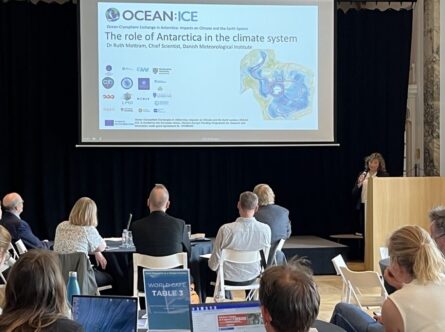
Organiser and details: Held on 3rd June 2025, 2 - 5 pm BIP (in person only) at Coudenberg, Former Palace of Brussels, in collaboration with the projects PolarRES, CRiceS, OCEAN: ICE, PROTECT, and ESA, in a world cafe format.
Key messages:
Several common priorities emerged from the world cafe session: The need for broader data coverage and continuity, support for both incremental and breakthrough research, and deeper international and interdisciplinary collaboration. Meeting the challenges of polar climate change will demand not only technical innovation but also strategic coordination and long-term investment.
The event reaffirmed the importance of polar regions in the global climate system and demonstrated the value of Horizon-funded research in advancing our collective understanding. While scientific progress is evident, substantial knowledge gaps remain. As the European Union looks ahead to the Horizon Europe framework and beyond, strengthening polar research capacities and linking science with policy will be essential to shape a resilient, climate-neutral future.

Briefing Nr 3
Future-proofing the EU through Polar Science: A call for sustained research and strategic investment
For whom: European Institutions, and several high-profile EU decision-makers.
The four EU-funded Projects — PolarRES, CRiceS, PROTECT, and OCEAN ICE — have joined forces to emphasise the crucial role of polar research in advancing Europe’s climate resilience and strategic autonomy. Their insights are presented in the newly released policy brief, “Future-Proofing the EU Through Polar Science: A Call for Sustained Research and Strategic Investment”. Building on the collective work of the four projects, the brief urges continuous, mission-driven investment in polar observation, modelling, and innovation within the upcoming EU Multiannual Financial Framework (2028–2034) and the Tenth Framework Programme (FP10).
Resources available: The text of the briefing is available here https://polarres.eu/polarresnews/new-policy-brief-future-proofing-the-eu-through-polar-science/
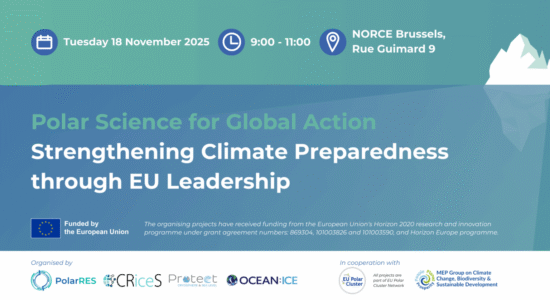
Organisers and details: Held on 18 November 2025, from 9-11 am, at NORCE Brussels, in collaboration with the MEP Intergroup on Climate Change, Biodiversity & Sustainable Development and the EU Polar Cluster.
Key messages:
The message from the research community is clear: Europe cannot afford to retreat from the poles. Long-term investment in polar science is essential to uphold the EU’s climate objectives, maintain global leadership, and safeguard environmental and strategic security.
• SUSTAINED FUNDING UNDERPINS RELIABILITY: A dedicated polar programme under the Framework Programme for Research and Innovation in the 2028–34 Multiannual Financial Framework, paired with funding criteria that protect incremental advances, will secure continuous time-series observations and model development.
• POLAR RISKS MUST BE INTEGRATED INTO EUROPE’S ADAPTATION STRATEGIES: Polar-driven climate impacts directly affect European resilience and should be embedded in national adaptation plans, civil protection systems, and foresight strategies.
• TIPPING POINTS DEMAND URGENT ATTENTION: Research must focus on identifying thresholds and low-probability, high-impact events, such as ice-sheet collapse or extreme polar storms, that could trigger cascading global risks.
• BETTER FORECASTING REQUIRES BETTER MODELS: Developing high-resolution, polar-relevant Earth system models that capture critical feedbacks is key to reliable climate forecasting at scales relevant for decision-making.
• INNOVATION CAN SHARPEN FORESIGHT: Integrating AI and machine learning into polar modelling, anchored in physical principles, will improve the accuracy and policy relevance of climate prediction.