
Factsheets and Infographics
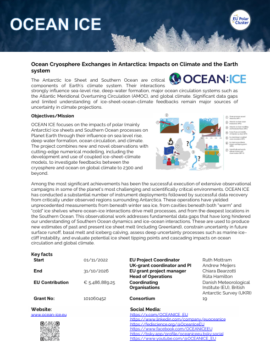
Here you can find a series of factsheets and infographics that unpack the complexity of OCEAN ICE. Discover the project and feel free to spread the message with your networks!

Key facts and results (update January 2026)
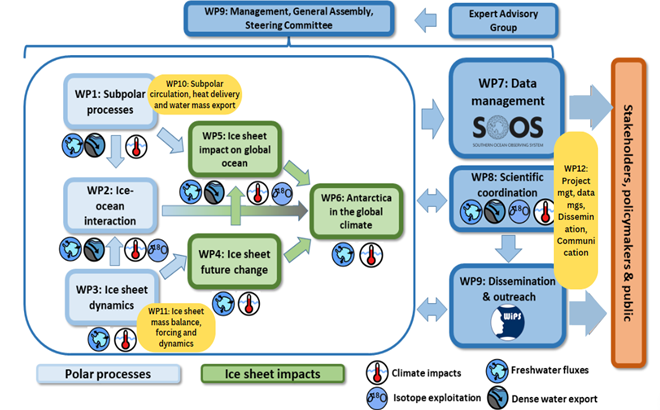
Fig.1: Work packages and workflow.
The future melting rates of the AIS and, to a lesser extent, the Greenland Ice Sheet, are recognised as primary uncertainties in existing decadal projections of key metrics such as SLR, ocean circulation stability and global mean surface temperature. On longer timescales, from centuries to millennia, poorly understood feedbacks between the ocean and ice sheets dominate the uncertainty in these projections. OCEAN ICE takes an integrated view of this problem, and its Work Packages map directly onto the objectives. WPs are structured to span from a physical process understanding level up to global impacts, and to the communication of these findings to the scientific assessments.
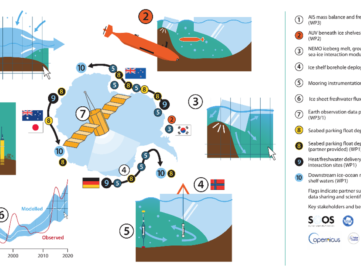
Fig.2: Antarctic and Southern Ocean activities, a graphic summary.
OCEAN ICE employs a cross-disciplinary, combined observational and modelling approach to achieve its scientific objectives: It melds new in situ measurements, targeted at existing spatial and knowledge gaps, with remotely-sensed EOs together with a hierarchy of modelling approaches from regional process studies up to the development of critically needed global coupled ice sheet-ocean-climate models. OCEAN ICE emphasises the need for a circumpolar approach to fully capture the impacts and feedbacks among the AIS, the southern and global ocean and climate. Our observational and modelling approach may be broadly divided into two regions: the interaction of the AIS with the surrounding Southern Ocean (figure above) and the broader impacts of ice-sheet freshwater fluxes on the global ocean and climate, with a focus on the Atlantic basin and the AMOC.
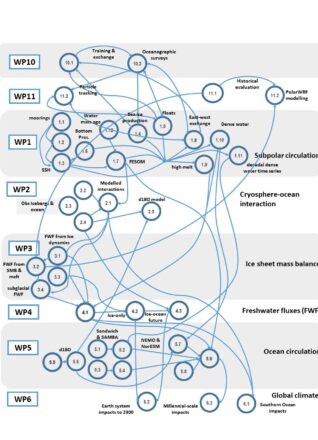
OCEAN ICE elements are highly coupled to maximise the benefits of interdisciplinary collaboration. The flow of deliverables is shown in Figure 3.1, demonstrating the fundamental process studies in WP1-3 supporting later model construction and analysis (WP4-6) and the structured nature of the model experimental design (Section 1.2.4.3). These links demonstrate added scientific value, but the successful attainment of most deliverables is not critically dependent on earlier ones. Note that WP8 provides additional coordination on cross-cutting themes beyond these deliverables through regular storyline meetings. WP10 is docked to WP1 and focuses on implementing the oceanographic component of WISH-OI and linking results to WP1. WP11 is docked to WP3 and focuses on implementing dynamical atmospheric and ocean modelling to integrate with WP3 in OI. WP12 is docked to WP7, WP8, and WP9 and mirrors OI WP7 on data management, WP8 on scientific coordination, and WP9 on communication, dissemination, and exploitation. Other OI partners, specifically BAS and AWI, will be indirectly involved in the tasks of these work packages at no cost.
Fig.3: Interconnections between work packages and deliverables.