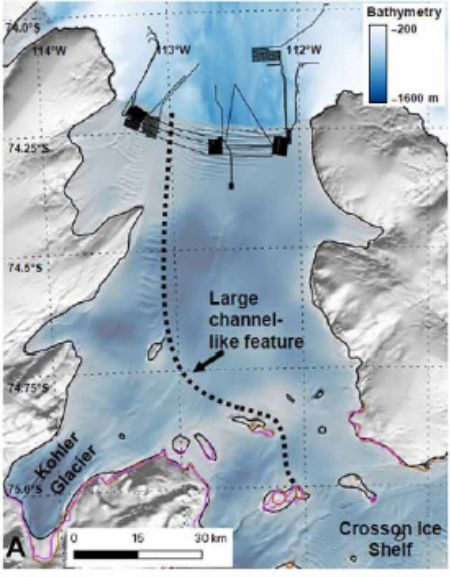

The autonomous underwater vehicle, Ran, was programmed to dive into the cavity of Dotson ice shelf, West Antarctica, and scan the ice above it with an advanced sonar. For 27 days, the submarine travelled a total of over 1.000 kilometres back and forth under the glacier, reaching 17 kilometres into the cavity. An ice shelf is a mass of glacial ice, fed from land by tributary glaciers, that floats in the sea above an ice shelf cavity. We have previously used satellite data and ice cores to observe how ice shelves change over time. By navigating the submersible into the cavity, we were able to get high resolution maps of the ice underside. In Science Advances the researchers report on the findings of this unique survey. Some things are as expected: The glacier melts faster where strong underwater currents erode its base. Using the submersible, scientists were able to measure the currents below the glacier for the first time and prove why the western part of Dotson Ice Shelf melts so fast. They also see evidence of very high melt at vertical fractures that extend through the glacier.
But the researchers also saw new patterns on the glacier base that raise questions. The base is not smooth, but there is a peak and valley ice-scape with plateaus and formations resembling sand dunes. The researchers hypothesize that these may have been formed by flowing water under the influence of Earth's rotation. There is a wealth of processes left to discover in future research missions under the glaciers. Todays models cannot explain the complex patterns we see. The field work for this study was conducted in 2022. In January 2024, the group returned with Ran to Dotson Ice Shelf to repeat the surveys, hoping to document changes.
However, they were only able to repeat one dive below Dotson ice shelf before Ran disappeared without a trace.
Read the Paper here: Swirls and scoops: Ice base melt revealed by multibeam imagery of an Antarctic ice shelf | Science Advances
The author of the article - Anna Wåhlin (University of Gothenburg)