

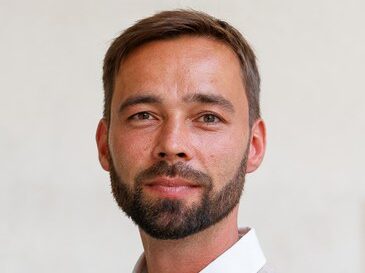
Torsten, please introduce yourself.
I am Torsten Albrecht, and I lead the Ice Dynamics theme in the Earth Resilience Science Unit (ERSU)—a new bridge group between the Potsdam Institute for Climate Impact Research (PIK) and the newly founded Max Planck Institute of Geoanthropology (MPI-GEA) in Germany.
Tell us about your professional and academic career before becoming part of the OCEAN ICE community.
I am a climate physicist and have been a co-developer of the Parallel Ice Sheet Model (PISM) for more than 15 years. My research focuses on Antarctic ice-shelf dynamics, including processes such as tabular iceberg calving, sub-shelf melting, damage evolution, and their interactions with ice-sheet flow.
Using PISM, I investigate feedback loops within the ice sheet and between the ice, ocean, and solid Earth, with the goal of better understanding potential tipping dynamics of the Antarctic Ice Sheet.
To deepen process understanding and assess global consequences, I have contributed to coupling PISM with adjacent Earth-system components and have applied it across both long paleo timescales and deep-future scenarios.
What do you do within OCEAN ICE?
Within OCEAN ICE, I am co-leading the Work Package 6 (WP6) together with Tony Payne.
Together with PhD candidate Moritz Kreuzer and Postdoc Johannes Feldmann at PIK, we have coupled PISM to a coarse-scale climate model (CM2Mc) to systematically explore ice-ocean feedbacks around Antarctica, such as the meltwater–stratification feedback.
What have you enjoyed about OCEAN ICE so far?
I truly enjoy being part of this exciting community. The project brings together people with different scientific backgrounds, models, and toolkits, and the exchange during meetings and discussions is incredibly enriching.
Earth system models no longer describe just one complex system—they have become complex systems themselves. Advancing our understanding requires exactly this kind of collaborative environment, where bright minds interact, challenge each other, and develop new insights together.
Tell us about a skill or trait unique to you that you would like to share?
Besides science and family, I am also a beekeeper. It’s a hobby that brings a kind of “yoga” into my life—working and interacting with bees requires calmness, focus, and the use of all senses.
But beekeeping also offers a fascinating perspective on complex systems. Like the Earth system, a bee colony responds to external forcings, self-regulates the hive climate, and organizes itself through communication and cooperation to maintain resilience.
Observing or even being part of such a well-organized natural system is inspiring. It motivates me to study the self-regulating mechanisms of the Earth system, and to see how human society can play a constructive role—even in times of multiple, overlapping crises.
Stay tuned on our social media channels (X, Mastodon, LinkedIn and Bluesky) for more of the series of OCEAN ICE 'Researcher in the Spotlight' articles.