

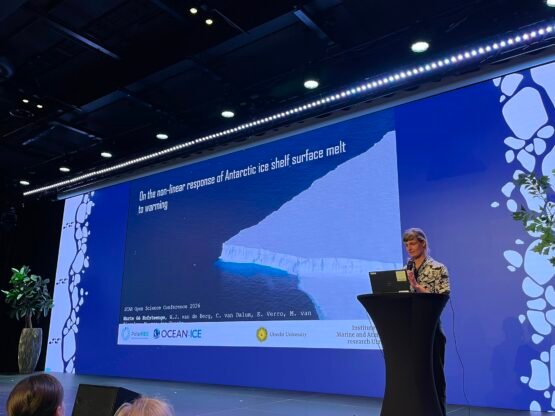
Marte Hofsteenge presented at SCAR 2026, in Oslo, Norway, on 'The non-linear response of Antarctic ice shelf surface melt to atmospheric warming'.
Surface melt on Antarctic ice shelves can have important implications for their stability and, ultimately, for Antarctica’s contribution to global sea level rise. Surface melt increases with atmospheric warming, but the response is strongly non-linear, and the processes driving this response remain incompletely understood. Therefore, we assess the temperature sensitivity of individual surface energy balance components to explain the non-linear melt response.
We use the latest RACMO2.4p1 simulations, forced with ERA5 to study the temperature-melt relationship during the observational period, and with CESM2 and MPI-ESM under the SSP3-7.0 scenario to examine projected melt under future warming. We show that for ice shelves in relatively dry climates (i.e., regions with little snowfall), strong albedo feedbacks dominante the non-linear response. In wetter regions, more frequent snowfall dampens albedo feedbacks. Here, enhanced downward longwave radiation from atmospheric warming, moistening and increased cloudiness becomes the main driver of the non-linear melt response. As summer mean air temperatures approach 0°C, the surface cannot warm beyond the melting point, while the atmosphere can, causing turbulent fluxes to further amplify melt.
We also show spatial variability in the temperature-melt relationship across Antarctic ice shelves. Melt starts to increase at lower temperatures on drier ice shelves compared with wetter ones, because of the stronger snowmelt–albedo feedback in dry regions. These results suggest that currently colder, drier and stable ice shelves may experience rapid increases in melt under future warming, with implications for their long-term stability.
It was nice session and fun to present at SCAR, we had some discussion on which albedo feedbacks are included in regional climate models, in which could be missing. And some more questions on role of clouds in driving melt for ice shelves in wet conditions, while at ice shelves in drier climates the albedo discussion was more relevant.
The author of the article - Marte) Hofsteenge (Utrecht University)