

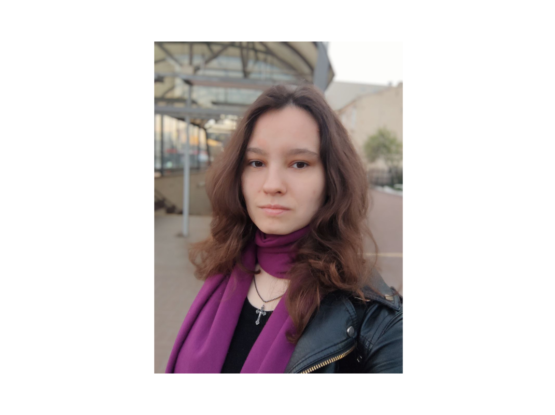
Kateryna, please introduce yourself.
My name is Kateryna Kovalets, I'm a PhD student in The Institute of Mathematical Machines and Systems Problems of the Ukraine National Academy of Science.
Tell us about your professional and academic career before becoming part of the OCEAN ICE community.
I obtained my master's degree in applied mathematics in Taras Shevchenko National University of Kyiv. The topic of my PhD research is migration of particle-reactive radionuclides in the ocean. I study vertical transport of radionuclides such as Pu-239,240 and Cs-137 in the ocean water and sediments using as Eulerian and Lagrangian modelling as well as analytical methods.
What do you do within OCEAN ICE?
My work was related to OCEAN ICE project was in frame of WP10 Subpolar circulation, heat delivery and water mass export and Deliverable D10.3 – Particles track from model and observations.
I'm developing an Eulerian-Lagrangian model of the fluxes of sinking organic particles in the ocean. I was applying a CMIP output data to my model in order to improve its agreement with measurements and add new parameterisations. I use my model to simulate organic fluxes globally, particularly in the Southern Ocean and in North Atlantic and Pacific.
What have you enjoyed about OCEAN ICE so far?
What I have enjoyed most about OCEAN ICE so far is the opportunity to work with a wide range of new datasets. These data have already led to interesting insights into current model performance and have revealed many possibilities for future model development, including the implementation of new processes and parameterisations. Exploring these opportunities is both exciting and rewarding, as it helps deepen our understanding of ocean processes and their role in the climate system.
Tell us about a skill or trait unique to you that you would like to share?
I'm always looking for the physical meaning behind the mathematical formulas. I enjoy seeing physical reality, real-world processes effects and mechanisms standing behind the abstract mathematical equations.
Stay tuned on our social media channels (X, Mastodon, LinkedIn and Bluesky) for more of the series of OCEAN ICE 'Researcher in the Spotlight' articles.