

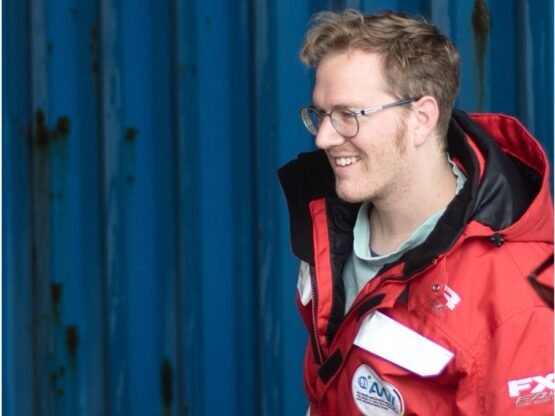
Simon, please introduce yourself.
Hello, I am Simon Reifenberg from the Alfred Wegener Institute in Germany, where I work in the Physical Oceanography section. As a seagoing oceanographer, I usually analyse and interpret observational data which are collected during ship-based expeditions. I recently finished my PhD on sea ice-ocean interactions and turbulence below sea ice in the Arctic, and joined OCEAN ICE afterwards.
Tell us about your professional and academic career before becoming part of the OCEAN ICE community.
I received my bachelor’s and master’s degrees in Meteorology and Computational Sciences at the University of Mainz (Germany), a very fine city by the Rhine. During an exchange semester on Svalbard in 2016, I got hooked on polar oceanography. From then on, I hoped that someday I could work in this field again. Eventually, this worked out! Following scientific work on atmospheric chemistry and sea ice predictability, my PhD position at the Alfred Wegener Institute finally brought me back to the topic. I investigated the interplay of meltwater stratification and small-scale turbulence below sea ice in summer, something that’s a bit tricky to observe but quite important for better understanding the oceanic controls on sea ice growth and melt. During that time, I learned many things that are now helpful for my current work at OCEAN ICE. My next step will be taking up a postdoc position at the Norwegian Polar Institute in Tromsø.
What do you do within OCEAN ICE?
I am contributing to WP1, and my work is centered around the collection and interpretation of observations during a Southern Ocean cruise with RV Polarstern in early 2026. During the expedition, I provided support from land through preliminary analyses of the collected data, which can be helpful for adjusting sampling strategies, identifying dubious sensors, and developing first working hypotheses on the observed physical processes. After the cruise, we dove straight into the proper data analysis, for which my focus lies on the role of tides in modulating heat transport on the continental shelf in the western Weddell Sea. This is a region where there exist only few observations historically, which makes the work quite exciting.
What have you enjoyed about OCEAN ICE so far?
I appreciate the opportunity to become a part of an established research network and to work on a state-of-the-art observational dataset together with great colleagues. Since I was focused on Arctic oceanography before, I currently learn many new things about the Southern Ocean, which I genuinely enjoy.
Tell us about a skill or trait unique to you that you would like to share?
While this is certainly not unique, I likely have a more-than-usual appreciation for music—live or otherwise—and cinema (based on a non-representative poll of colleagues and friends). This also became a way of staying grounded during particularly intensive work periods.
For example, whenever I'm traveling for a conference or other reason, I usually check whether there is a coinciding concert, exhibition, or film festival in town (assuming there’s some free time). Two memorable examples were the Bergen International Film Festival during a research stay in Norway, and a concert in Cambridge—where a colleague happened to be performing—during a visit to BAS. These occasions remind me that creativity and curiosity can be expressed in so many ways, and that it’s always rewarding to keep an eye on life beyond science.
Stay tuned on our social media channels (X, Mastodon, LinkedIn and Bluesky) for more of the series of OCEAN ICE 'Researcher in the Spotlight' articles.